
Precise and reliable protein biomarker analysis provides valuable insight into how a therapeutic, active ingredient or formulation affects target biological pathways. From evaluating efficacy and mechanism of action to monitoring inflammatory responses and supporting clinical and cosmetic claim substantiation, researchers need sensitive and reproducible methods to quantify protein biomarkers and support translational research. Meso Scale Discovery (MSD) is the gold standard for protein quantification and offers a high-throughput, flexible technology to support your research and development goals.
What is Meso Scale Discovery (MSD)?
Meso Scale Discovery (MSD) is an electrochemiluminescence-based immunoassay platform designed to detect and quantify proteins, biomarkers and other analytes with high sensitivity and wide dynamic range.
MSD allows for multiplexing using capture antibodies bound to patterned arrays on a multi-spot plate. Signals are quantified using electrochemiluminescent labels that produce light signals in response to an electrical current. This multiplexing capability allows researchers to evaluate multiple biological markers simultaneously, while conserving sample volume and streamlining analysis.
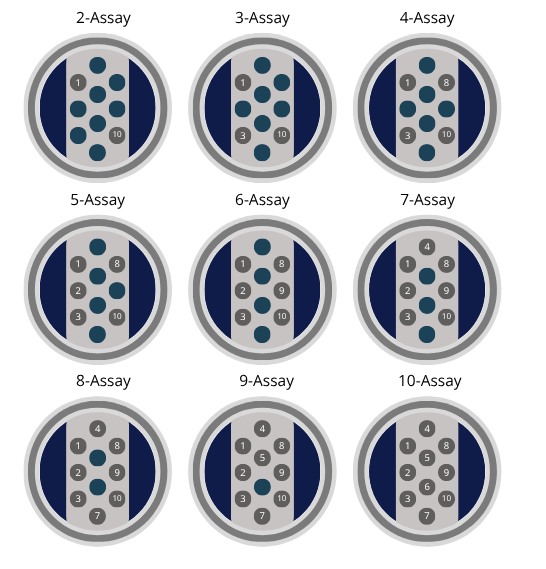
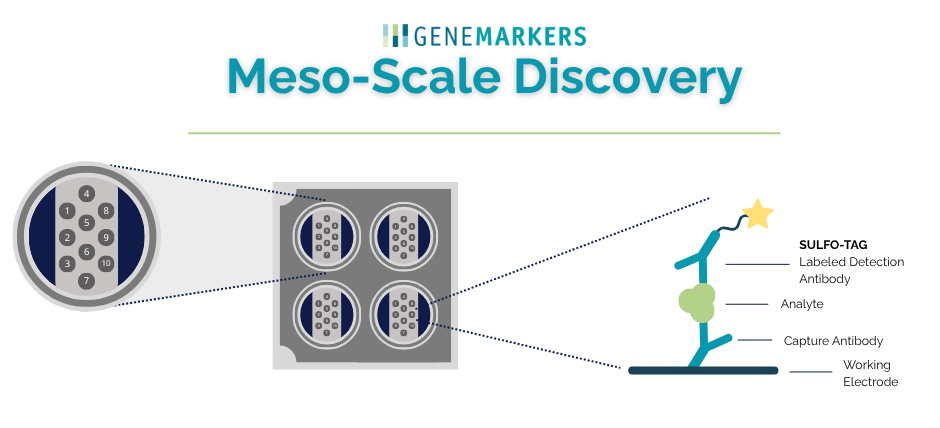
Image Shows a 10-spot well plate highlighting Meso Scale Discovery’s multiplexing capabilities. Anywhere between 2-10 assays can be run on a single plate.
How Does MSD Work?
MSD works through a straightforward, multistage process:
- Capture: Target molecules in the sample bind to specific capture antibodies coated on the assay.
- Detection: Secondary antibodies labeled with electrochemiluminescent tags attach to the capture molecules.
- Stimulation: An electrical current is applied, causing the tags to emit light.
- Detection and Quantification: The emitted light is measured. Signal intensity is used to quantify the amount of target analyte in the sample.
Because of its multiplexing capabilities, MSD can provide a broader view of biological responses while requiring relatively small sample volumes.
When Should You Use MSD?
MSD technology offers a unique combination of sensitivity, efficiency and flexibility, making it a useful tool throughout the research and development pipeline. It is especially valuable when research requires sensitive protein biomarker measurements, multiplexed analysis or efficient use of limited samples.
Key advantages of MSD include:
- High Sensitivity: Detects low-abundance proteins and biomarkers.
- Multiplexing Capabilities: Measure multiple biomarkers, conserving both time and valuable sample material.
- Small Sample Volume Requirements: Generate comprehensive data from limited or precious samples (e.g., in vitro cell cultures and media, in vitro skin models, tissue explants, or biofluids).
- Flexible Assay Formats: Choose from single-plex, multiplex, or customized panels tailored to your study’s needs.
- High-Throughput and Cost-Effective Analysis: Streamline complex studies with efficient, reproducible testing that reduces overall cost rapid turnaround of data.
These features make MSD valuable across a range of research applications, from evaluating the biological activity of consumer product ingredients to investigating therapeutic responses during pharmaceutical development.
Applications of MSD Across Research Divisions
Applications in Consumer Products & Personal Care Research
For the personal care and cosmetics industry, MSD helps researchers better understand how active ingredients and formulations influence key biological pathways.
Applications for the Consumer Product industry include:
- Evaluating ingredient efficacy and biological activity
- Investigating mechanisms of action
- Measuring inflammatory or oxidative stress responses
- Understanding potential effects on the skin barrier
- Comparing the performance of different active ingredients
- Assessing dose-response and synergistic relationships
- Supporting science-backed product claims
Example: A formulation may lead to visible aesthetic improvements; with protein biomarker analysis, researchers gain additional insight into what is happening at the molecular level and which biological pathways contribute to the observed effect.
Applications in Biopharmaceutical Research and Development
In pharmaceutical research, MSD is used for protein biomarker analysis throughout preclinical, translational and clinical research.
Applications for the Pharmaceutical Industry Include:
- Quantify pharmacodynamic, prognostic, predictive and safety biomarkers
- Demonstrate a drug is hitting its biological target or pathway
- Characterise immune activation and inflammatory responses
- Investigate mechanisms of action
- Analyze clinical patient samples for biomarkers and treatment response
- Companion Diagnostics & Patient Stratification: Identify patients likely to respond to treatment
Using MSD helps provide a more comprehensive view of how a therapeutic influences important biological pathways.
How MSD Differs from ELISA
Both MSD and enzyme-linked immunosorbent (ELISA) are established immunoassay technologies for measuring proteins and other analytes. The optimal choice depends largely on study objectives, sample availability, the number of biomarkers and the study’s sensitivity requirements. However, MSD, often considered the gold standard for protein quantification, provides distinct advantages over enzyme-linked immunosorbent assay (ELISA).

ELISA is best suited for straightforward, single-analyte measurements with moderate sensitivity requirements. By contrast, MSD is the preferred platform when high sensitivity, wide dynamic range, and multiplexing are required from limited sample volumes.
Why Choose MSD Services
MSD is a powerful tool for generating high-quality protein biomarker data that can accelerate research and development across both personal care and biopharmaceutical applications. By combining sensitivity, reproducibility and efficiency, MSD enables better-informed decisions across applications.
Genemarkers provides comprehensive MSD services from sample processing through data analysis and final reporting. Our team helps design studies to answer specific research questions, supports selection of appropriate biomarkers, and integrates protein analysis with complementary endpoints to support therapeutic or product claims.
About Genemarkers
Genemarkers is a CLIA-certified, CAP-accredited contract research laboratory specializing in genomic and molecular testing services for the consumer products and pharmaceutical industries. Our services include gene and protein biomarker analysis, histology, sample collection kitting, in vitro models, ex vivo tissue samples, and computational data analysis. We support consumer product companies, ingredient developers, manufacturers, pharmaceutical companies, and drug developers with research designed to evaluate biological activity, efficacy, safety, mechanisms of action, and therapeutic or formulation responses. Genemarkers delivers reliable, high-quality data that helps reduce risk, accelerate timelines, and bring innovative therapies to market.